
As a wife and mom of three kids seven and under working full-time outside the home, peace seems unattainable at best or, at worst, a mythical fabrication spread to give women like me a false sense of hope.
However, as a Christian woman who was raised in the Church and has witnessed God’s provision, protection, and inundating peace, I know that the peace of God is attainable for everyone in every circumstance. We need only to be still and trust in Him.
When we’re talking about peace, though, what is it really? In my life, “peace” can feel as foreign as going to the bathroom without a tiny chaperone.
Merriam-Webster defines peace several ways, but my favorites are, “a state of tranquility or quiet, such as: … freedom from disquieting or oppressive thoughts or emotions; harmony in personal relations.”
As for God’s peace, Merriam-Webster doesn’t have a definition for it, but I know a book that does.
The Bible talks about God’s peace often in stories where ordinary people wind up in extraordinary situations where all that is left to hold onto is the peace of God. Philippians 4:6-7 tells us that the peace of God “transcends all understanding.”
The same passage councils us to worry about nothing, but in every situation, to pray for what we need and to give thanks to Him for what He has already provided. When we do this, God’s peace will guard our hearts and minds in Christ Jesus. We can surrender our fears and worries to God knowing that through His beloved Son, we are safe and secure in Him. God’s peace provides comfort even when situations are difficult or incomprehensible.
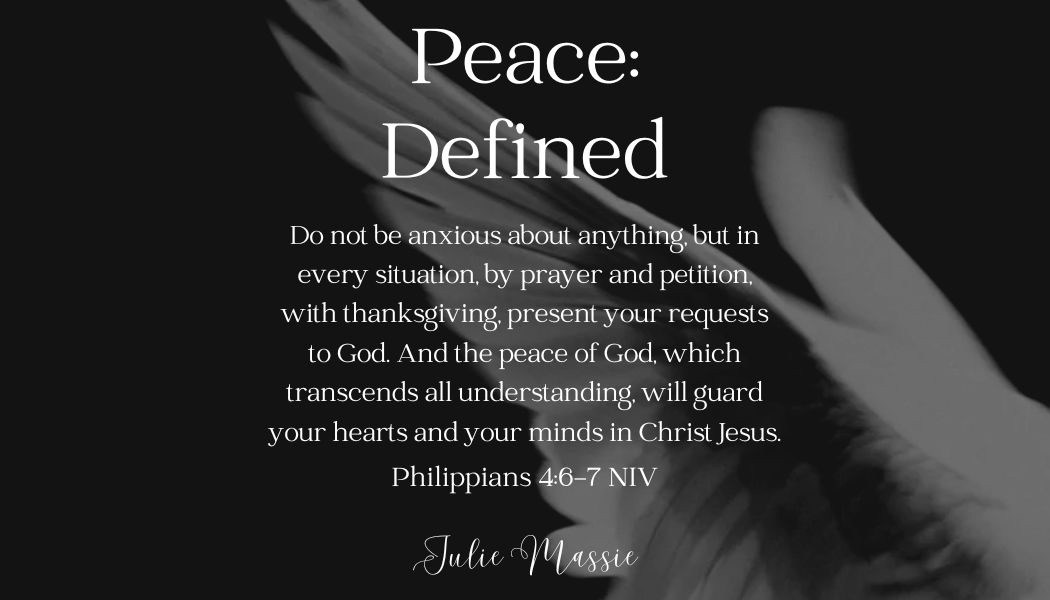
“Do not be anxious about anything, but in every situation, by prayer and petition, with thanksgiving, present your requests to God. And the peace of God, which transcends all understanding, will guard your hearts and your minds in Christ Jesus.” Philippians 4:6-7 NIV

The peace of God is a profound sense of well-being and tranquility that comes from trusting in God’s sovereignty, presence, and promises. God’s peace doesn’t equate to the absence of conflict or stress. In fact, in John 16:33, Jesus tells us that we WILL have trouble. But he continues by telling us to take heart, that He has overcome the world. God’s peace is a deep-seated assurance that God is in control, regardless of external circumstances.
“”I have told you these things, so that in me you may have peace. In this world you will have trouble. But take heart! I have overcome the world.”” – John 16:33 NIV
Having God’s peace means living with an inner tranquility that comes from being in a right relationship with God. His peace is beyond human understanding and explanation. Through a relationship with Christ, the Prince of Peace (Isaiah 9:6), and our unwavering faith, God’s peace remains steadfast and unshakable, comforting us in times of trouble.
In summary, God’s peace is an inner serenity that comes from a deep relationship with God, trust in His control, and reliance on His promises. It allows believers to navigate life’s challenges with calm and confidence, knowing that God is with them and for them.

Five ways to live out God’s peace in our lives:
- Engage in Regular Prayer: Communicate with God regularly to express your worries and seek His peace.
- Meditate on Scripture: Read and reflect on Bible passages that speak about God’s peace and promises.
- Practice Gratitude: Cultivate a heart of thankfulness, recognizing God’s blessings in your life.
- Foster Healthy Relationships: Seek to live in harmony with others, promoting peace in your interactions.
- Trust in God’s Promises: Remind yourself of God’s faithfulness and His promises to never leave you nor forsake you.

Finally, I’m going to leave you with a meme that makes me smile from the movie Miss Congeniality. “What is the one most important thing our society needs?” “World peace.”

Leave a Reply